Are KL Serviced-Apartment Prices Rising in 2026?
KL serviced-apartment prices rose 1.8% in Q2 2026P. See what NAPIC's KL Centre, North and South data means before comparing projects.
Short answer: Yes. NAPIC’s preliminary Q2 2026 data shows Kuala Lumpur serviced-apartment prices rose 1.8% from a year earlier and 0.3% from the previous quarter. Prices are moving up, but slowly. Buyers still have room to compare projects and question an asking price that is not supported by recent transactions, realistic rent or the building’s condition.
For buyers, the useful part of the report is not the 1.8% figure alone. It is the difference in price and growth between KL Centre, KL North and KL South. These are NAPIC’s statistical areas, not names used to market individual projects.
What an Index Level of 106.1 Actually Means
Kuala Lumpur’s Serviced Apartment Price Index reached 106.1 points in Q2 2026P. NAPIC uses 2018 as the starting point of 100, so 106.1 means the index was about 6.1% above its 2018 starting level. It does not mean prices rose 6.1% in the latest quarter or year.
What the Three KL Regions Cover
“Kuala Lumpur” in the first row is the overall city benchmark. The next three rows divide the city into NAPIC’s broad statistical areas:
- KL Centre: Sections 1 to 100, Mukim Kuala Lumpur and Mukim Ampang.
- KL North: Mukim Batu, Mukim Setapak and Mukim Hulu Klang.
- KL South: Mukim Petaling and Mukim Cheras.
A mukim is an official land-administration area. It is broader than the neighbourhood names buyers normally use.
KL Centre, for example, does not mean KLCC alone. Before using a regional figure, confirm which NAPIC area contains the project’s exact address.
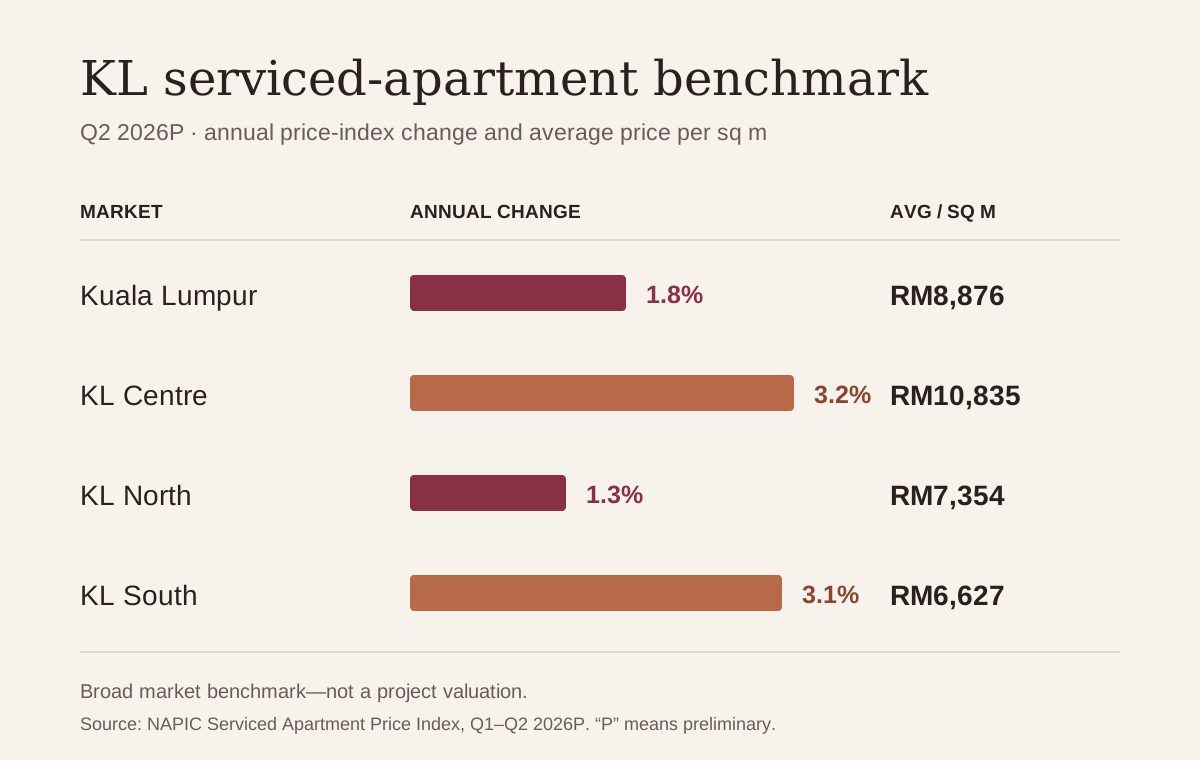
The table below answers two different questions. “Annual change” shows how the regional index moved compared with Q2 2025. “Average price” shows the typical level across transactions used in that regional model. Neither number is a valuation for a particular building or unit.
| Market | Annual change, Q2 2026P | Average price per sq m | Average price per unit |
|---|---|---|---|
| Kuala Lumpur | 1.8% | RM8,876 | RM768,926 |
| KL Centre | 3.2% | RM10,835 | RM962,474 |
| KL North | 1.3% | RM7,354 | RM644,740 |
| KL South | 3.1% | RM6,627 | RM596,022 |
Source: NAPIC Serviced Apartment Price Index, Q1 to Q2 2026P. The figures are preliminary and cover broad market groups rather than individual projects.
For readers used to square feet, the regional averages are roughly RM1,007 per sq ft in KL Centre, RM683 in KL North and RM616 in KL South. These are conversions from NAPIC’s per-square-metre figures, rounded to the nearest ringgit.
Where Each Region Deserves a Closer Look
The report does not identify a winning project. It gives buyers three starting points.
KL Centre: test the premium
Highest annual growth at 3.2% and the highest average price at RM10,835 per square metre.
A central address can justify a premium, but the building still needs strong access, condition and likely tenant or resale demand.
KL South: investigate the lower entry level
Similar annual growth of 3.1% at a much lower regional average of RM6,627 per square metre.
That does not make it automatically better. It's worth investigating if the project is well managed, practical to reach and suitable for a clear group of future buyers or tenants.
KL North: demand stronger unit evidence
Grew more slowly at 1.3%, with an average of RM7,354 per square metre.
Slower regional growth is not a reason to reject every project there. It's a reason to check the individual building and avoid paying for a broad market story.
The opportunity across all three areas is selective buying. Buyers can compare completed stock, study competing listings and negotiate without assuming every acceptable unit will disappear immediately.
Different Tests for Own Stay and Investment
Buying for your own stay
Start with daily travel, space, affordability and how long you expect to live there. Market growth matters less if the home does not suit your routine.
Buying for investment
Test achievable rent against maintenance charges, vacancy and competing listings. A positive price index cannot repair a weak rental calculation.
Buying from overseas
Check whether the unit can be managed, rented and resold from a distance. Building management and the likely resale audience may matter more than regional growth.
Regional Data Cannot Price One Unit
NAPIC combines many transactions into a regional benchmark. A buyer purchases one unit in one building.
Two serviced apartments a few kilometres apart can face different demand. Rail access, building age, maintenance and competing listings can all affect the price.
Even two units in the same development may deserve different prices because of their floor, layout, view, noise or condition.
The regional labels are broad as well. KL Centre’s 3.2% growth should not be treated as the performance of every project in KLCC, Bukit Bintang or the wider city centre. The figure combines transactions across a much larger NAPIC area.
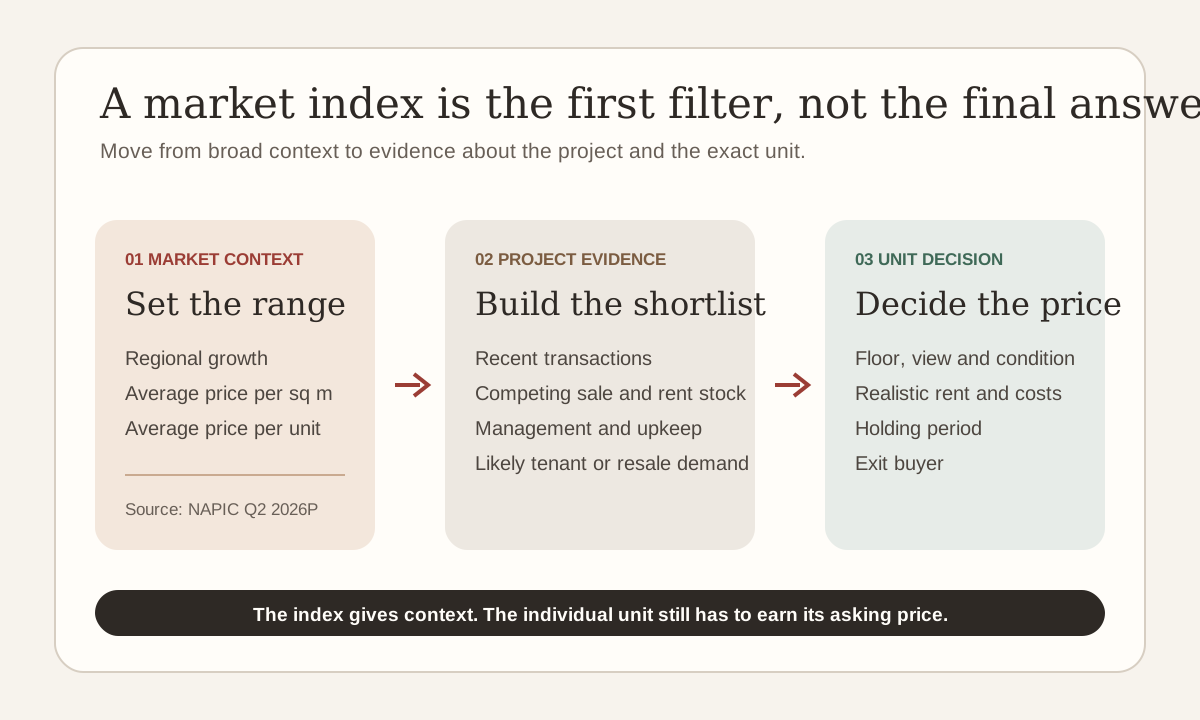
Five Checks Before Shortlisting a Unit
-
1
Recent transactions
Compare units of a similar size, floor, condition and view. Asking prices show what sellers want, not what buyers paid.
-
2
Competing listings
Count similar units for sale and rent in the building and nearby projects. Heavy competition can affect rent and resale time.
-
3
Realistic rent
Allow for maintenance charges, sinking fund contributions, vacancy and other ownership costs.
-
4
Building condition
Check management quality, recurring charges and visible upkeep.
-
5
Future buyer
Identify who may buy the unit from you later. A clear resale audience is more useful than a vague "prime location" claim.
A Regional Benchmark Is Not a Target Price
If a seller asks substantially more than the regional average or recent comparable transactions, the unit needs a clear reason for the premium. A better view, renovation, layout or position may support it. A marketing claim does not.
Price movement and supply risk should also be read together. The index shows that broad serviced-apartment prices have been resilient.
Our KL property-overhang guide explains why unsold supply can still vary by category and location. A market can record modest price growth while individual projects face very different competition.
If you have shortlisted two or three KL serviced apartments, send Edwiin the project names, asking prices and whether you are buying for your own stay or investment. He can help you organise the comparison before you decide which property deserves closer attention.
Common questions
What does "Q2 2026P" mean?
The "P" means the Q2 2026 figures are preliminary. NAPIC may revise them in a later release.
Is KL Centre the same as KLCC?
No. KL Centre is NAPIC's broader statistical area covering Sections 1 to 100, Mukim Kuala Lumpur and Mukim Ampang. KLCC is only one location within the wider central market.
Is a serviced apartment the same as a condominium in this report?
No. The report tracks NAPIC's serviced-apartment category. Its averages should not be applied to every residential condominium.
Is RM768,926 the fair value of a KL serviced apartment?
No. It is the report's Kuala Lumpur average per unit. Fair value for a particular unit requires recent comparable transactions and adjustments for its condition, floor, view and other relevant differences.
Does positive price growth guarantee a positive rental return?
No. The price index does not measure the rent, vacancy, maintenance costs or net yield of your unit.
Related guides
 Market News
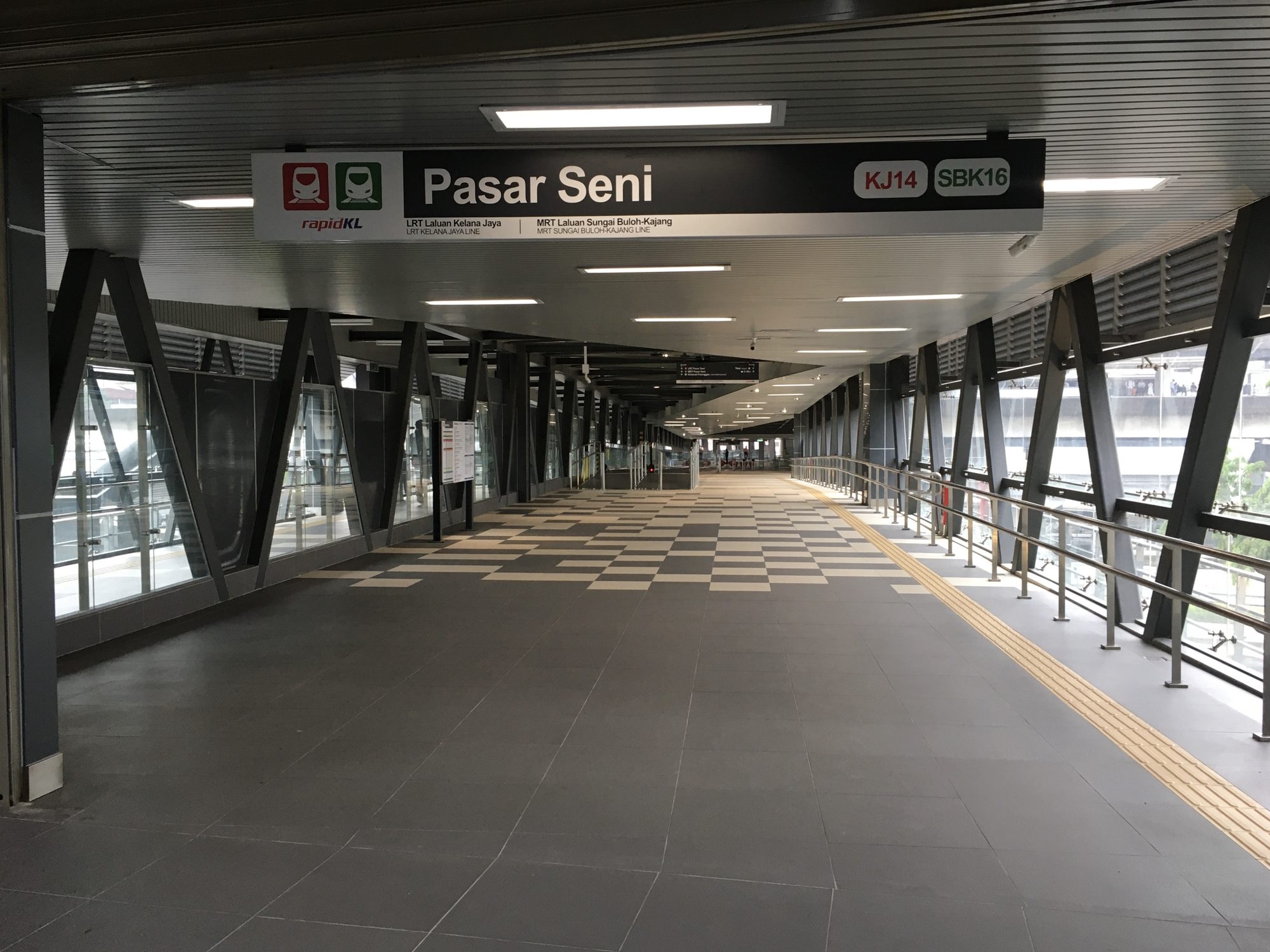
Budget 2027's KL Covered Walkway: Will It Reach Your Condo?
Budget 2027 announces a 22 km KL covered walkway and names Masjid Negara, Dataran Merdeka and Pasar Seni. See what a condo buyer can verify.
 Market News
KL New Residential Launches in H1 2026: Read the 20.7% Sales Figure Carefully
NAPIC recorded 1,610 newly launched KL residential units and 334 sold in H1 2026. See what the 20.7% rate can tell a new-launch buyer.
 Market News
Budget 2027: What You'll Actually Notice
Pet vet bills, AI subscriptions and sports shoes are proposed as tax-deductible for YA2027, plus wage, relief and first-home stamp duty changes.